 Available in US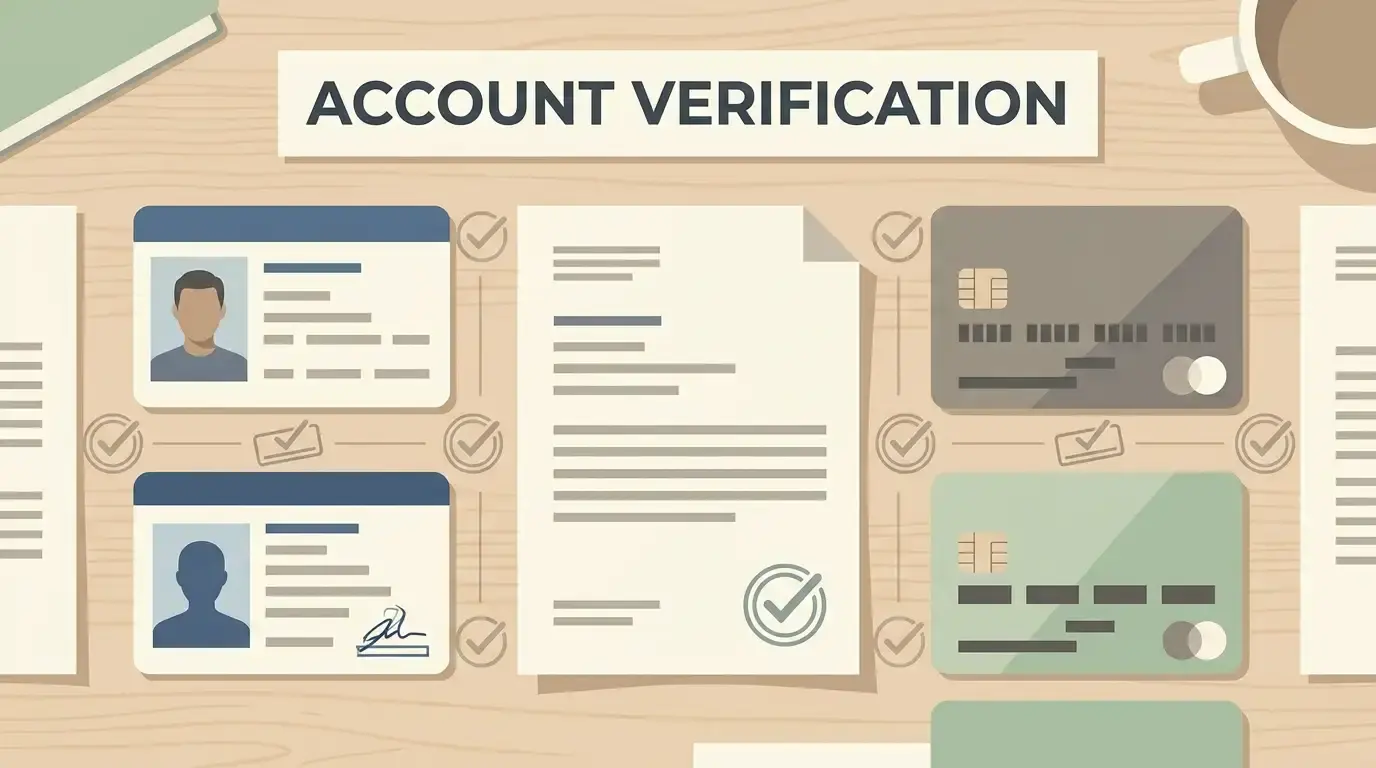
AmunRa can require identity verification before or after a deposit or withdrawal. For an Australian reader, the practical point is that KYC is not merely a sign-up formality: it can become part of the cashout process. AmunRa material also shows document examples such as identity, address and payment documentation in verification-related contexts. Those examples should be treated as categories rather than a fixed checklist for every account, because additional checks can be requested.
AmunRa’s terms state a 10-day review period after a complete response, while also allowing additional time or checks. That is not a guaranteed completion deadline. If a withdrawal is pending, verification can therefore affect when the payment process moves forward. Preparing an account and understanding verification are separate from exact payout limits and cashout rules, which are covered on the withdrawals page.
Registration: what to get right at the start
A clean verification process begins with consistent registration data. Use your own details and keep the name, date of birth, address and payment ownership information consistent with the documents and payment instruments you later use. AmunRa states that it accepts customers aged 18 or over, and its help material says each player can create only one account. These basics matter because mismatched account data can create extra questions when a withdrawal or compliance review occurs.
Registration confirms only that the account flow was available in that context. An Australian address field, AUD display or a technically reachable registration form should not be used to infer broader conditions. The licence and Australia page covers the separate regulatory context.
When KYC can happen
AmunRa’s terms allow KYC checks around several stages of the customer relationship, including before or after deposits and withdrawals. In practice, this means a player should not assume that making an initial deposit without a document request guarantees that no verification will be needed later. A check may arise when account information, payment ownership or a withdrawal needs to be validated.
The useful planning assumption is simple: if you intend to withdraw, be ready for verification before the cashout is completed. This is more realistic than treating KYC as an exceptional event. It also explains why a payment request can remain unresolved even when the payment method itself is working normally.
Document categories: examples, not a universal checklist
Verification material can cover several different questions: who owns the account, where the account holder lives, and whether the payment method belongs to that person. AmunRa promotional terms give examples including a copy of ID, proof of address and proof of payment when the operator considers documentation necessary before crediting a bonus or processing related winnings.
- Identity documents: a current document that can establish the account holder’s identity.
- Address documents: material used to confirm the residential details recorded on the account.
- Payment documents: information used to establish ownership or legitimate use of a deposit or withdrawal method.
- Additional documents: further material can be requested when the first submission does not resolve the verification question.
Do not treat those examples as an exhaustive list that applies identically to every account. The exact request depends on the check being performed. Sending unrelated documents pre-emptively is not necessarily helpful; a better approach is to follow the request shown in the account or sent through the operator’s support channel.
What happens after documents are uploaded
AmunRa’s current help centre says that after documents are uploaded successfully, their status automatically changes to ‘Under review’. It also says there is no need to contact support merely to trigger the review. This is useful because it gives the player a concrete status to look for after submission rather than relying only on an email acknowledgement.
Before assuming an upload failed, check the verification area for the status of each requested item. Keep your own record of what was submitted and when. If the site asks for a replacement or a clearer version, respond to that specific request rather than repeatedly sending the same file.
How long verification can take
AmunRa’s terms state a 10-day document review period after a complete response, with the possibility of additional time or checks. The important qualifier is ‘complete response’: a new request for information can change the practical timeline because the operator may still consider the verification incomplete.
For that reason, the 10-day wording should not be presented as a promise that every account will be cleared within ten calendar days. It is better understood as the operator’s stated review framework, subject to further verification. Independent player reports also show that some cases have involved repeated KYC rounds, but individual reports do not establish a standard processing time for everyone.
Why KYC and withdrawals are connected
A withdrawal is where identity, payment ownership and account controls often become operationally important. AmunRa’s terms permit verification in connection with withdrawals, so a pending KYC request can interrupt the path from withdrawal request to payment. That does not mean every delay is caused by KYC, nor does it mean a completed KYC check guarantees a particular payout date.
Separate the two processes when diagnosing a delay. First ask whether the verification request is complete and marked as under review or approved. Then look at the withdrawal status and the operator’s payment-review rules. The dedicated withdrawal guide compares the official review framework with reported delay signals without treating either as a universal outcome.
Practical verification steps
- Register with accurate personal details and avoid duplicate accounts.
- Use payment methods that you are entitled to use and can document if ownership is queried.
- Read each KYC request carefully and provide the requested category of document rather than a random bundle of files.
- Check that scans or photographs are complete and readable before uploading them.
- After upload, confirm that the website shows the document as under review.
- Keep dates and copies of submissions so you can explain the sequence if another check is requested.
- If the stated review framework has passed with no status change, use the operator’s support channels and refer to the exact outstanding verification item.
- Keep KYC questions separate from payment-method availability, withdrawal limits and the Australian regulatory position.
These steps cannot guarantee a faster decision, but they reduce avoidable ambiguity. The most useful objective is to make the account information, payment ownership and submitted documents internally consistent.
Common mistakes that create confusion
One common mistake is assuming that a successful deposit means the account has already passed all identity checks. A second is treating a document example found in promotional terms as a permanent universal list. A third is assuming that a support conversation itself completes KYC. The current help centre instead points users to the document status on the website after upload.
Another mistake is treating verification as proof of broader account or regulatory conditions. KYC is an operator compliance and account-control process, so it should be assessed on its own terms.
If verification becomes a dispute
If the issue is not simply a pending review but a disagreement about what has been requested or whether supplied documents were accepted, keep the communication factual. Record the request, your response, upload status and subsequent operator message. AmunRa publishes a complaints route and lists live chat and email support. For wider questions about external protection and regulation, use the dedicated trust guide.
For readers evaluating the wider risk rather than one verification ticket, see AmunRa licence and Australia for the regulatory position and AmunRa complaints and reputation for independent complaint patterns. These are separate from account verification requirements.
KYC checklist before requesting a withdrawal
- Account name and personal details match your identification.
- Residential information is current and can be documented if requested.
- The payment method is yours or otherwise permitted under the operator’s rules.
- Requested files are legible and show the information the request is intended to verify.
- You have checked the verification status after uploading.
- You understand that further checks can extend the process beyond the initial review wording.
- You have not confused KYC completion with a guaranteed withdrawal completion time.
The core takeaway is that AmunRa verification should be planned for as a possible cashout dependency. Prepare consistent account information, answer the actual request, monitor the review status, and check the payment and regulatory sections for issues that sit outside KYC itself. For a broader view of the brand, see the AmunRa Casino Australia review.
Reading a verification request carefully
A verification request is easier to handle when it is broken into the question the operator is trying to answer. An identity request is about the person controlling the account. An address request is about residence information. A payment request is about the relationship between the account holder and the funding method. These purposes overlap, but they are not interchangeable. A clear identity document does not necessarily prove a current address, and an address document does not necessarily prove ownership of a payment instrument.
That distinction also helps when a second request arrives. A follow-up does not automatically mean the first file was rejected in full. It may mean that one field was unclear, that another verification category has become relevant, or that the operator is carrying out an additional check permitted by its terms. Read the new request literally and compare it with what has already been supplied before responding.
For privacy, submit documents only through the channels the operator designates for verification and avoid sending extra sensitive material that was not requested. Where a file contains information irrelevant to the stated check, follow the operator’s current upload instructions rather than improvising edits that could make the document unacceptable. The objective is a readable, responsive submission, not the largest possible document bundle.
What to record if verification takes longer
If verification extends beyond the initial stated review framework, a simple timeline is more useful than repeated general messages. Record the date of the first request, the date each file was uploaded, the status shown after upload, any follow-up request and the date of your response. If a withdrawal is also open, record that separately so the KYC timeline and payment timeline do not become confused.
When contacting support, refer to the outstanding item and the relevant dates. Ask whether the verification submission is complete or whether a specific document is still required. This creates a clearer question than asking only why a withdrawal has not arrived. If the issue later becomes a complaint, the same chronology makes it easier to show what was requested and how you responded.
The full picture is in the AmunRa review for Australian players.
The next step is funding the account in AUD.
This material was created by the AmunRa Casino Australia team.
